


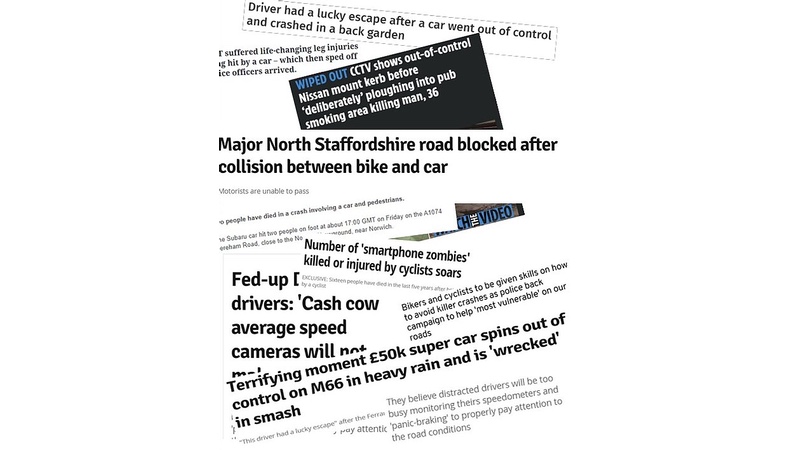
The UK’s first media reporting guidelines for road collisions are being launched for consultation. This is aimed at helping journalists, broadcasters and publishers improve the public debate around road safety. Members of the public, interested groups and organisations, are invited to respond.
While guidelines already exist for reporting on suicide, children and refugees, for example, none specifically guide best practice around reporting of road collisions.
Road crashes claim more than 1,700 lives a year in the UK alone, and cause life-changing injuries for thousands more. Worldwide, road collisions are now the leading cause of death for young people (aged 15-29). On a more subtle level, road danger fundamentally impacts daily lives and how safe people feel in public.
The consultation notes that collisions and their causes can too often be misinterpreted or misrepresented. By confusing public debate, this risks hampering genuine progress in tackling road crime and improving road safety.
Road danger can disproportionately affect the poorest and most vulnerable in society and the COVID-19 crisis has laid bare inequalities in how streets are used, with increases in road collisions despite a dramatic fall in road traffic.
The draft guidelines are produced by the University of Westminster’s Active Travel Academy in collaboration with national roads policing, academics and experts in the field, road safety charities, and the National Union of Journalists’ ethics council, and advised by IMPRESS.
The guidelines’ four main clauses aim to guide core journalistic principles of accuracy, fairness, non-discrimination and justice.
The guidelines, if adopted, will form an ‘industry standard’ to help pave the way for better reporting in broadcasting, online and in print.
Chris Boardman, British Cycling Policy Advisor, said “Having worked for nearly two decades to get people riding bikes for health, leisure and utility journeys, I can say categorically, that reporting of cycling activity and particular incidents, has a huge influence on perception. For good or ill, words really do matter, they paint a picture and influence both how we feel about a topic and how seriously we take a crime.
“My British Cycling colleagues and I have been frustrated for years about how tragic occurrences are often painted as unavoidable accidents rather than the result of very avoidable criminal behaviour. So, we very much welcome that this topic is at last being addressed and that guidelines are being crafted to ensure those who are truly responsible for road violence are the ones in the spotlight.”
John Ranson from the National Union of Journalists’ ethics council said “Good reporting should inform. It should help the public understand what has happened. And good opinion journalism should provoke debate and challenge the audience. But too much of the media’s coverage of road collisions has played into and reinforced lazy generalisations. We hope these guidelines will equip journalists to report on road collisions with accuracy and humanity, bringing the same standards of integrity to this topic as to any other.”
Professor Rachel Aldred, director of the Active Travel Academy, at the University of Westminster, said “Research shows that how crashes are reported shapes how we think about and respond to them, sometimes in quite problematic ways. So, it is crucial that journalists have guidance helping them with current best practice around road collision reporting, as exists for other issues such as suicide and domestic violence.”
The four clauses in the proposed guidelines each aim to align with journalistic values that inform existing reporting guidelines:
1.1 Impartiality: publishers must not use the term accident when describing road collisions – collision, or crash, are more accurate, especially when the facts of the incident are not known.
1.2 Discrimination: publishers must avoid using negative generalisations of road users, and must not use dehumanising language or that which may incite violence or hatred against a road user in comment and news coverage.
1.3 Accuracy: coverage of perceived risks on the roads should be above all accurate, based in fact and context. Publishers should make mention of human actors in a collision, and avoid reference to personal protective equipment, such as hi-vis and helmets, except when demonstrably relevant.
1.4 Reporting on crime: publishers must avoid portraying dangerous or criminal behaviour on the roads, such as speeding, as acceptable, or those caught breaking the law as victims.
The closing date for consultation responses is midnight on Sunday 8 November. Responses will be assessed by a working group. The first Road Collision Reporting Guidelines will be officially launched at this year’s Active Travel Media Awards, on 26 November 2020, and published on a dedicated website.