


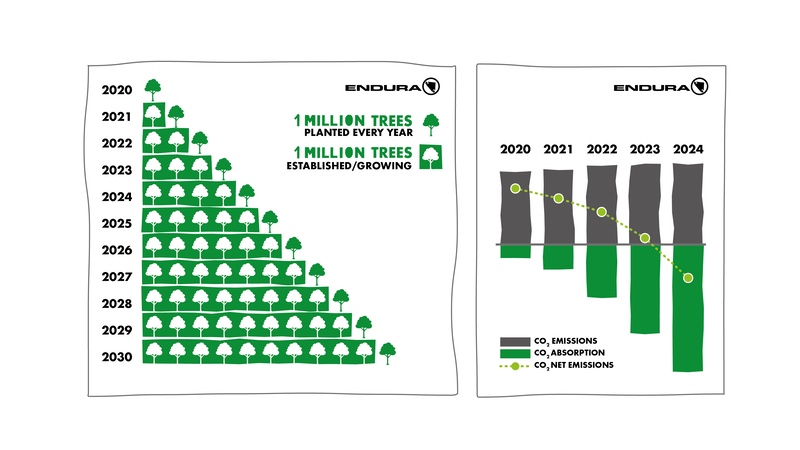
Cycling apparel specialist Endura planted over 1.3 million trees in 2020 and expects to become carbon negative by 2024.
When Endura launched its One Million Trees initiative at the start of 2020, it committed to planting one million trees annually for the next 10 years to ultimately eliminate the brand’s carbon footprint. With the help of its reforestation partners, the first year’s target was exceeded by 30%, with more than 1.3 million mangroves planted in the Maputo Bay area of in Mozambique. The company also plans to start planting in Scotland soon.
With this important milestone met, Endura has now set a bold new target – to become carbon negative by 2024.
Pamela Barclay, Endura’s co-founder and Brand Director, said “With Covid-19 tragedy and disruption affecting communities around the world, it has meant so much more to have hit our Million Trees target this year and it is a phenomenal start, but it’s just year one.
“Our ten year commitment to match this level of planting will deliver real benefits and enable Endura to achieve carbon negative status very quickly.”
She added that “reducing our environmental impact is core to everything we’re doing at Endura; carbon offsetting, removing PFCs, designing for longevity, use of recycled fabrics and materials, and in-house repair services are part of a companywide approach that takes us further on our journey. We still have a long way to go, but we’re heading in the right direction.”
In a project led by Endura’s founder and Managing Director, Jim McFarlane, the company’s activities right from fabric production to product end-of-life have been examined to calculate total carbon emissions in order to quantify the sequestration required to neutralise.
The main driver of emissions for Endura continues to be the production of the materials required to manufacture its range of apparel and accessories. Each step in the manufacturing processes emits CO2 into the environment.
Collaboration with other brands in the Pentland Brands portfolio and across the industry will be required to help switch upstream suppliers to renewable energy to make a meaningful reduction in this element. Even so, the amount of CO2 per unit produced is forecast to reduce by 7% per year resulting in a 25% reduction between 2020 and 2025. This is expected to continue to decline at 6% year-on-year as China’s green energy projects start to come on-stream.
The transport of goods from the production powerhouses in the Far East forms the next largest segment of Endura’s emissions. The company plans to reduce the use of air freight by 75% over the next two years, partly by switching to overland train services when sea freight is too slow.
Sending orders out to Endura’s network of dealers and direct to consumers also has an impact on emissions but given that the relative distances are much smaller it has a lower impact than the process of moving containers from East Asia to its main markets in the UK, Europe and US.
Endura’s manufacturing, warehousing and design base in Scotland also has a footprint – mainly the electricity and natural gas used to power its 5,000 square metre facility in Livingston. The biggest reductions in emissions will come chiefly by switching to renewables, particularly for electricity, and this is something that is currently being pursued.
Cumulatively, the activities under the direct control of Endura represent around 74% of the total CO2 impact of its clothing. Consumer use – predominantly washing – contributes around 20% to a garment’s environmental impact/ and significant reductions can be made by influencing consumer behaviour in washing and extending the product’s life span.
Endura estimates that retail activities contribute 3% of an item’s emissions, with end-of-life management adding a similar proportion.
Planning has started on an initiative to retrieve and fully recycle products alongside packaging such as LDPE bags, something that’s already in place as part of the European Outdoor Group’s Single Use Plastics project.
By pledging to plant one million trees per year over a ten-year timeframe, the carbon capture effect compounds – as more and more trees are planted and then begin to reproduce naturally. This will see Endura first balance out the CO2 that its activities produce, and then move beyond this to remove much more carbon from the atmosphere than its emit.
By 2030, Endura forecasts that its net footprint will lock away more than 100,000 tonnes of atmospheric CO2 each and every year.