


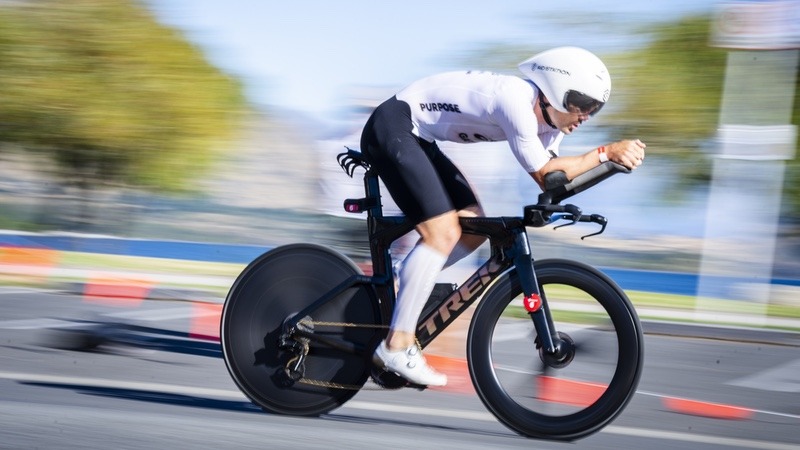
Held in New Zealand on February 13-15, 2025, Challenge Wānaka saw a world-first age-group trial of RaceRanger – the drafting detection system designed to enhance fair play on the bike leg of a triathlon.
Approximately 270 individual amateur (age-group) athletes had the opportunity to test RaceRanger, providing feedback as the technology moves closer to large-scale implementation.
RaceRanger co-founder and CEO James Elvery said “We’re really pleased with how the trial went.
“The feedback from athletes has been overwhelmingly positive. Many appreciated the clarity RaceRanger provided – eliminating any guesswork around drafting distances and making the racing experience fairer.
“One athlete told us, ‘Now there’s no question about the distance – you have to be honest with yourself and other athletes.’ That’s exactly what we want to achieve.”
While this trial was a key step, scaling RaceRanger to thousands of athletes remains the ultimate goal. Here, the challenge lies in refining the technology to be more user-friendly, self-managed, and easily scalable.
Currently, each bike is fitted with two devices that use light indicators to show drafting distances. The next step involves connecting these devices to the internet, making them completely self-guiding, and enabling their use as live trackers. This will offer real-time data for spectators, technical officials and race organizers.
“We chose Wānaka because it’s the perfect size event to test what needs to change before we can scale up,” Elvery added. “We need to streamline distribution – ideally, in the future, athletes will pick up RaceRanger units in their race packs and fit them themselves. We also need to improve device activation, management, and post-race retrieval.”
Challenge Wānaka was a step toward transitioning RaceRanger from a prototype to a fully scalable product that can be used by serious competitors and recreational triathletes alike. The technology has been well-established in the professional field, but expanding to age-group racing is seen as essential for the company’s growth.
“There are only so many pro races in the world,” Elvery continued. “To truly make RaceRanger viable, we need to take it further and reach the mass participation market.
“This trial doesn’t mean we’re jumping to a 3,000-athlete event next month – but it’s a key step in that direction.
“We’ve got a lot of engineering work ahead to refine the system, from enhancing usability to ensuring seamless connectivity for larger race fields.”
Beyond drafting detection, the future of RaceRanger could see it becoming a tool for race tracking, athlete safety, and enhancing the spectator experience. “We’re looking forward to seeing how this device can aid the sport in more ways than just drafting detection,” Elvery said.
www.challenge-wanaka.com
www.RaceRanger.com