


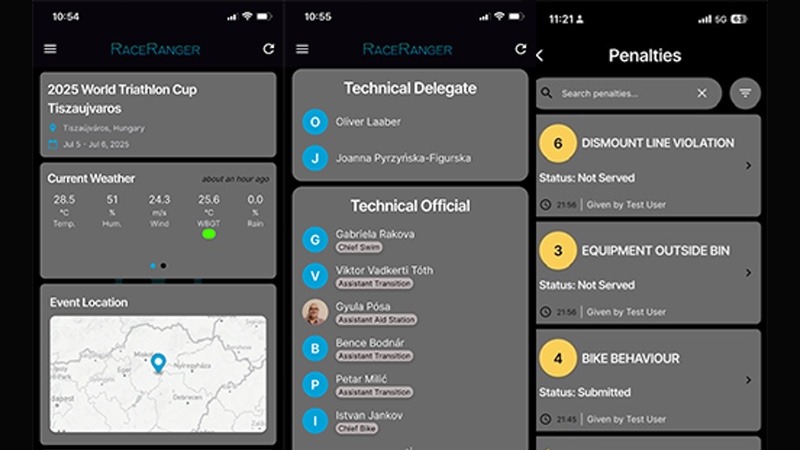
World Triathlon is undertaking trials of a new RaceRanger digital platform aimed at supporting triathlon event management and officiating.
To support consistent drafting enforcement, RaceRanger was originally developed as a drafting detection system. This provides officials with insights, improving decision-making and enhancing the overall integrity of racing. While penalties remain part of the sport, the system’s primary goal is education and awareness of drafting whilst on the bike leg of a triathlon.
The new RaceRanger App is being tested at selected events – including WTCS Alghero, the Tiszaújváros World Cup, and WTCS Hamburg – and is designed to centralise communications, incident reporting and penalty management via a mobile interface.
The new app includes real-time AI voice recognition across multiple languages and can be accessed by officials, emergency services, commentators and team managers – even remotely.
World Triathlon President Antonio Arimany stated that the new platform reinforces the organisation’s commitment to innovation and raising officiating standards.
“This app is another milestone in our ongoing effort to empower event organisers, raise the standard of officiating, and reinforce our role as both regulator and enabler of triathlon globally,” said Arimany.
The new platform builds on RaceRanger’s on-bike drafting detection system and is expected to offer improved enforcement, particularly in non-drafting formats.
RaceRanger CEO and Co-Founder James Elvery said the company is working to enable real-time transmission of athlete positioning and drafting data.
“This will sharpen officiating accuracy and deter drafting violations more effectively than ever,” said Elvery. “It also opens the possibility of centrally alerting the race organisation when athletes have stopped or departed the course, which will be a huge safety improvement.”
The new RaceRanger App will work with or without RaceRanger’s on-bike hardware, making it accessible across a broad range of event formats and sizes. A full launch to national federations and private event organisers is expected in October 2025, with tiered access options.
Benefits include:
- For organisers: Scalable, digital officiating that reduces overheads and increases control
- For athletes: Consistent rule enforcement and improved safety
- For fans/media: Real-time data access for improved storytelling and race context
- For federations/series: A tool to professionalise race operations
www.raceranger.com
www.triathlon.org