



In a new series of featured news items, EnduranceBiz is going ‘inside the brand’ to find out a bit more about what makes brands tick, their positioning and what they offer an ever-changing marketplace. First-up we have athlete hormone monitoring specialist Hormonix…
Over the last few decades the attention given to the analysis of women’s performance has been somewhat behind that of male counterparts. Understanding that women cannot be trained like men, and that specific information about female physiology must be taken into account – if women are to perform at their optimum – is seen to be of the utmost importance.
With this in mind, Mint Diagnostics has developed Hormonix with the aim of closing this gender data gap.
Co-founders, Stefano Borini and Richard White, in partnership with Dr Richard Burden, the co-lead of Female Health and Performance at the English Institute of Sport, claim to have unlocked the value of female hormone data and delivered it to female sports’ professionals.
Simply put, they have made the process for monitoring female hormones easier and non-invasive. With the use of athletes’ saliva (rather than through needles and blood samples) and using a mobile app, samples can be frequently collected at home or at training locations.
From this, full hormonal profiles – rather than snapshots – can be obtained, allowing support staff to have precise data on athletes’ menstrual cycles.
Mint Diagnostics notes that, through its Hormonix platform, obtaining a better understanding of female athletes’ menstrual cycles will allow for an improved level of support. Jess Varley, a GB modern pentathlete based at the University of Bath, England, has benefited from a better understanding of her menstrual cycle through Hormonix.
“It gives me the confidence going forward that it doesn’t matter when a competition is and when it falls within my menstrual cycle because I now know we’ve got all my symptoms under control,” Varley said.
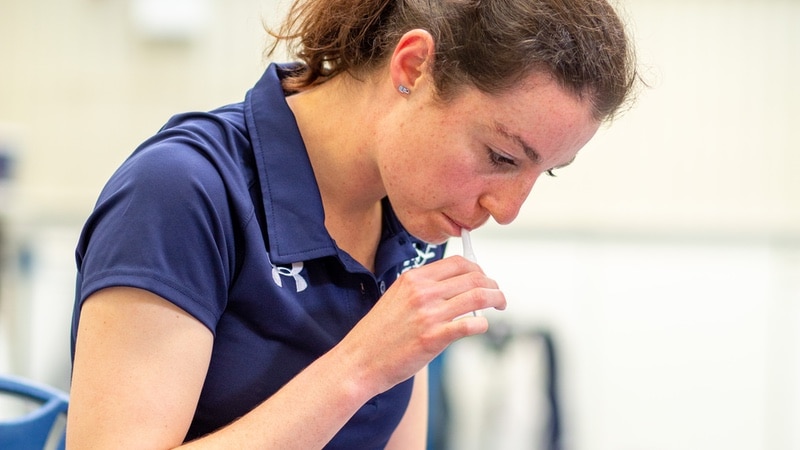
For elite female athletes in particular, it is important to know that training volume is not impacting their cycle. Different stages of the cycle have different effects on athletes. This might mean a need for more nutrition, extra massages or additional stretching. Having hormonal information to-hand allows for performance to be tailored and to be improved over time.
The Hormonix team point out that the human body is complex and clever – it certainly has the ability to override an individual’s behaviour if it believes that it is detrimental to one’s wellbeing.
One such example is RED-S (Relative Energy Deficiency in Sport), a broad spectrum syndrome that arises when athletes don’t get enough energy from their diet to fuel their training.
In women, one of the signs that an athlete is suffering RED-S can be when her menstrual cycle starts to become irregular; and left untreated, her periods stop altogether.
A mismatch between the energy that an athlete is taking in compared to what they are expending can result in a chronic deficit. This can lead the body into conservation mode that has short term effects on health and performance. But equally as worrying, are long term consequences such as bone health function and future fertility.
A study into menstrual cycle disorders in female athletes, published in October 2022 in the Journal of Environmental Research and Public Health, highlighted some findings for endurance athletes. The highest prevalence of primary amenorrhea (failure to reach the first menstrual period) was observed in middle and long distance runners.
For context, in the general population the occurrence of this event is less than 1%. Yet, within the studied athletes it was possible to notice that this prevalence was considerably higher, reaching 20%.
Furthermore, secondary amenorrhea was observed in cyclists (56%) and triathletes (40%) compared to the general population in which the estimated prevalence is around 5-12%. And the highest prevalence of oligomenorrhea, or infrequent menstrual periods, (47%) was also observed in endurance athletes.
The study concluded that a possible explanation could be related to training intensity combined with inadequate recovery. This can result in an energy deficit leading to suppression of the endocrine function and hypoestrogenemia (reduction in estrogen levels).
With the improved research that Hormonix generates, the brand adds that it can provide reassurance about an athlete’s menstrual wellbeing and flag potential energy deficiency issues at an early stage – often providing insights that would have otherwise gone unnoticed. This in turn will help female athletes on the road to achieving their true potential – safely and successfully.