


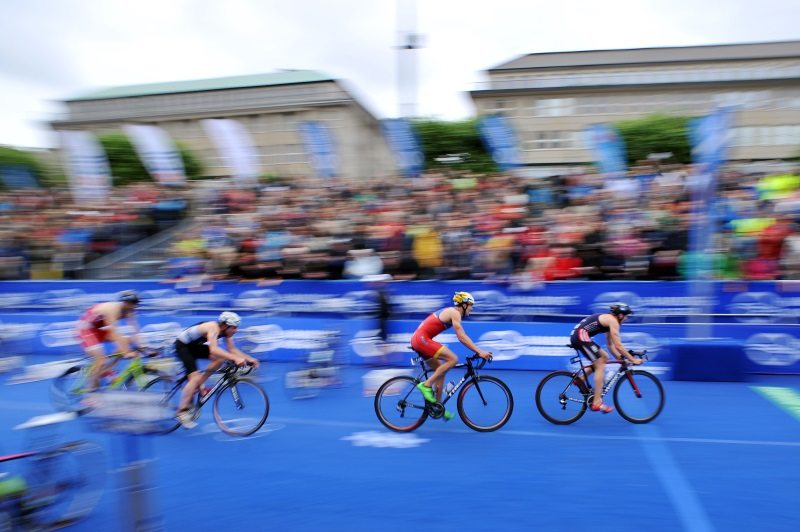
In recent weeks there has been speculation that the Olympic triathlon, next scheduled to take place at the Tokyo 2020 Olympic Games could change from the standard Olympic distance to be contested over the Sprint distance. The speculation was triggered following an interview between sports journalist Tim Heming and ITU President Marisol Casado.
In the interview, Casado indicated that the move from Olympic to Sprint distance could be possible at the next Olympics. Tim Heming posted an audio file of his interview with Casado to confirm that this was indeed the suggestion from the woman at the helm of triathlon’s international governing body. The ITU President then confirmed via Twitter that she was ‘Happy for people to hear this is my personal opinion on a possible scenario’.
Following up on this possible development at Tokyo 2020, the team at the Brighton and Hove triathlon have released an interview that they recently undertook with John Lunt, race organiser of the London 2012 Olympic triathlon and now the organiser of the Brighton and Hove triathlon. The short interview explores John Lunt’s thoughts on the proposed changes…
Q: If the changes did occur, what impact do you think it would have on the sport as a whole?
John Lunt (JL): I can see the reasoning behind it from a TV perspective, however I think it will be a backward step for the sport. We have had five very successful Olympic events. The world has accepted our sport. Triathlon is all about endurance and coping with the pressures of a long distance event, of around 2 hours. To make it a Sprint event will require a different animal than over the Olympic distance. The same applies in Rugby 7s versus Rugby 15 or the 100m and the marathon distance in athletics. They are completely separate beasts.
Q: How do you think the Brownlees would cope in 2020 if the changes were introduced?
JL: I’m sure that with their fantastic ability, the Brownlees would alter their training programme to become very fast sprint athletes. Although the risk of injury increases.
I’m sure the sprint distance would suit some athletes but not others. The general rule of thumb is the younger you are, the better you are over the shorter distance and as you get older, you go longer. That seems to be the general pattern of age and distance. Older athletes will struggle to cope in a sprint-drafting race in the Olympics.
Q: Would you like to see the distance changed and a relay introduced? Why/why not?
JL: No I wouldn’t like it. We need consistency over the distance and to educate the non-triathlon world what Olympic distance triathlon is all about. Yes, I would love to see the relay distance introduced as it’s great to watch, it’s fun and it’s exciting, with four athletes racing over the Olympic distance. It adds a new interesting dimension to the sport, without taking away the toughness of the individual Olympic distance. Having said that, team relay should not be at the expense of our iconic Olympic distance race.
The 2017 Brighton and Hove Triathlon is open to 2,000 competitors and will offer Olympic, Sprint (including draft legal), and Super Sprint distances. The organisers have also opened entries to youth and junior racing. The free Sport and Fitness Show running alongside the race hosted 70 exhibitors in 2016 and will also return for 2017 with more interactive sport activities for all the family.
www.brightonandhovetriathlon.com
www.sportandfitnessshow.com