



Silverstone Sports Engineering Hub in central England has launched its latest mechanical test rig for athletes – the Pedalling Efficiency Rig (PER).
The Pedalling Efficiency Rig acts as a bicycle dynamometer to measure rider input power and compare this with output power at the roller surface in a controlled environment, to determine the mechanical losses of a bicycle and thus its efficiency. This is claimed to be accurate than other methods currently in use.
Rolling resistance, component stiffness and chain friction can be measured in isolation with smaller mechanical test rigs. However the PER has been designed to measure efficiency of the dynamic system as a whole and how all components interact with each other to transmit rider power into forward motion.
Rider input power is measured at the pedals via a bespoke system to isolate left and right inputs. This provides radial and tangential forces, enabling force vectors through crank rotation to be plotted. In turn, this allows the evaluation of pedalling technique and its influence on power transmission and efficiency. High resolution measurements capture every single input pulse on the pedals and resultant accelerations.
A bicycle is mounted via the front forks using bespoke mounting fixtures, enabling the bike to pivot and roll. The rear wheel is in contact with a 2m diameter roller with interchangeable surfaces. The initial surface is velodrome wood; however, this will shortly expand to both a tarmac like and cobbled surface.
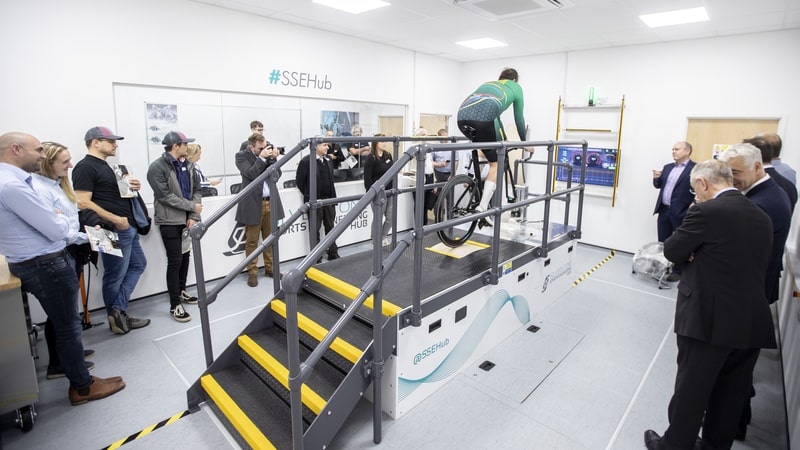
The PER rounds off a variety of services now available at SSEH, providing a one stop shop to both professional cycling teams and manufacturers, looking to optimise the performance of athletes and equipment.
Whilst riding on the PER, the bike generates its own resistance and losses through the tyres, drivetrain, bearings and frame deflection, however there is no aerodynamic drag for the bike and rider to overcome. To compensate for this, aerodynamic resistance is simulated and applied to the roller via electromagnetic resistance brakes, based upon wheel speed and a drag-velocity profile of a rider of a given CdA, taken from Wind Tunnel data.
Therefore, the resistance applied is representative of what a rider would encounter in the real world for a given speed and gradient, when following a particular course profile. With a known rider and bike mass, gravitational resistance for a specified gradient can also be applied using the same method, with the ability raise the front axle to the associated angle.
SSEH Managing Director Rob Lewis said: “The rig will open up new opportunities for teams and manufacturers to investigate the efficiency of the bicycle in a way that has not been possible before, encouraging future development and innovation within the sport.”
www.silverstonesportshub.co.uk