


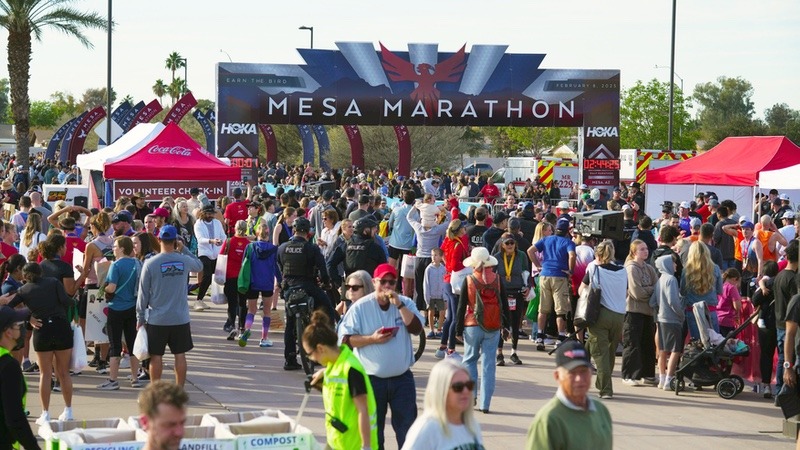
Held on February 8, in Mesa, Arizona, new race timing and athlete tracking technologies were deployed at the 2025 Mesa Marathon.
The Mesa Marathon in Arizona offers a marathon (26.2 miles), half marathon (13.1 miles), 10K and Amazon Kids 1K. The event is owned and produced by Brooksee.
Utilising Laurel, Brooksee’s timing technology, the event organiser deployed 167 timing checkpoints across the course. This delivered near real-time athlete positioning through Laurel’s patent-pending, active, disposable chip technology.
The event also featured the launch of Brooksee’s ‘Laurel Intelligence’ technology, which translates timing data into AI-generated race recaps, delivering a personalized, sharable experience for each race participant.
According to Brooksee… ‘The 2025 Mesa Marathon featured the highest timing checkpoint frequency in industry history, providing capabilities for near-real-time athlete positioning every 0.15 miles. This was a new benchmark for Laurel, which set the previous industry record of 0.18 miles at the Las Vegas Marathon and Every Woman’s Marathon in 2024.
‘At the finish line, Laurel by Brooksee delivered a 99.95% read rate, outperforming a leading legacy timing system used at the event, which recorded a lower 99.82% read rate. Missed reads were promptly verified and corrected using a backup.’
The 2025 Mesa Marathon saw over 10,000 registered participants from all US 50 states and 30 countries and over 25,000 spectators.
“The incredible surge in tracking and viewership at Mesa far exceeded our expectations, clearly demonstrating the demand for the participant and spectator engagement features that Laurel provides,” said Phil Dumontet, CEO of Brooksee.
“Increasing our server capacity to ensure real-time updates to match this unprecedented demand is our top priority. This level of engagement was beyond anything we’ve seen in past races, which strongly affirms our vision.
“As fans continue to engage more deeply, we’re resetting our goals and preparing for even greater growth – upgrading our infrastructure to support the scale of the biggest events ahead.”
Brooksee pointed out that… ‘Despite the high timing checkpoint density, the entire Laurel system was deployed in two hours by a four-person team. Each timing checkpoint is about the size of a smartphone. Compared to traditional timing mats, teams reported quicker installation, easier integration and higher reliability.’
“When I started timing more than 10 years ago, we were giving ourselves two hours to deploy just 4 or 5 checkpoints,” said Austin Pullan, Timing Operations Manager at Brooksee. “Our ability to deploy 167 checkpoints today in the same amount of time is incredible.”
Brooksee adds that Laurel was developed to elevate the experience for participants, spectators and race organizers at endurance sports events:
- For runners, race day moments live on long after the finish line with dynamic, data-driven reports and shareable recaps.
- For event directors and law enforcement, real-time visibility on athlete positioning enables faster response times, improved safety protocols and a more controlled race environment.
- For spectators, better real-time tracking of friends and family helps to eliminate guesswork and provide confidence of knowing where their runner is on the course.
In 2025, Laurel’s technology will support over 200 races across the US, including Ragnar Relay, Every Woman’s Marathon, Seattle Marathon, Las Vegas Marathon, Portland Marathon and Phoenix Marathon.