



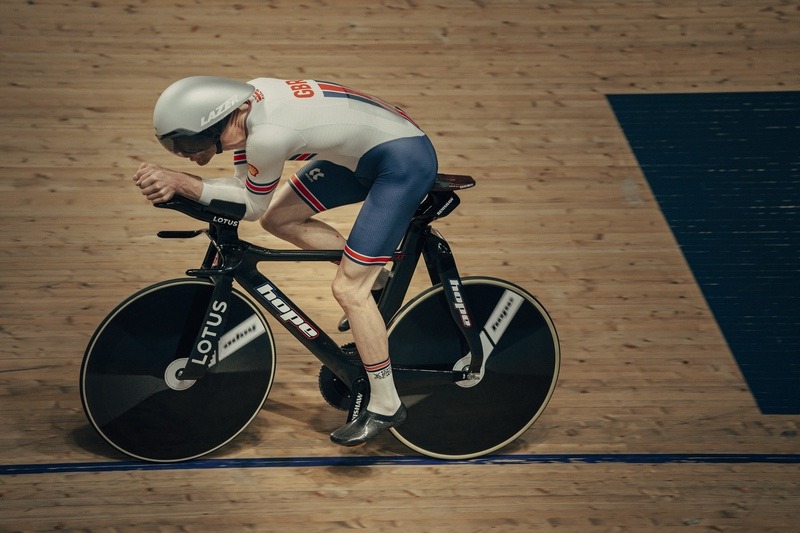
British Cycling has unveiled the latest version of the cutting-edge bike that will be ridden by Great Britain’s track cyclists at the Paris 2024 Olympic Games this summer.
Developed by the Great Britain Cycling Team’s in-house experts in collaboration with British engineering talent, the national governing body hopes that the bike will play a key role in helping the team maintain its record of success at the Olympic Games.
Following on from the success of the Tokyo track bike, the new evolved model has benefited from the continued partnerships with Lotus Engineering, Renishaw and Hope Technology.
Notable developments include a 3D-printed optimised Renishaw titanium crank, unique Lotus trailing-edged fork and handlebars that support increased aerodynamic positioning, as well as the Hope HBT Paris frame with refined Renishaw split seat post and headstays.
British Cycling adds that every component of the bike has been designed to work as one with the rider, bringing the machine and athlete together.
Stephen Park CBE, Performance Director of the Great Britain Cycling Team, said “British Cycling has a long and renowned history of being a world-leader in bike technology, and we are continuing to break new ground when it comes to the speed, efficiency and innovation of track bikes.
“For the Paris track bike, the team have continued to look to new and innovative solutions to deliver this impressive machine, which we believe will give our riders the best possible platform to succeed at the Paris 2024 Olympic Games.”

Mark Stringer, Commercial Director at Lotus Engineering said “Lotus’ longstanding collaboration with British Cycling has been pivotal in advancing the frontiers of sporting performance and engineering with the 2024 Hope-Lotus Olympic track bike.
“This ongoing partnership has enriched our depth of knowledge, further enhancing and embracing the innovation that proved successful in Tokyo. We’ve been able to continue pushing engineering boundaries in the pursuit of performance to deliver efficiencies and to give British track riders the best possible opportunity for success.
“The Hope-Lotus bike is the perfect demonstration of our ability to transfer the skills and knowledge we’ve gained through over 75 years of automotive development to bring a new perspective to other industries. We wish British Cycling the best of luck in the upcoming Olympics.”

Ben Collins, Lead Additive Manufacturing Application Engineer at Renishaw, added “We have been able to refine the design even further and showcase how additive manufacturing (AM) can deliver strong, yet lightweight parts for cycling, while demonstrating these benefits to other industries.
“Our aim for this Olympic bike is to push the boundaries with AM technology further, whilst still achieving high-performance components that are tailored to the riders and meet Olympic requirements for strength and weight.”
“We were delighted to be asked to continue our partnership with the British Cycling team and develop components for the Paris 2024 bike, and we can’t wait to see how the bike performs.”

Ian Weatherill, Director at Hope Technology, said “With our manufacturing and production based in Lancashire, being so close to the British Cycling base in Manchester, has allowed a close working relationship with the GBCT team throughout the new bike development process.
“Once again, our staff are proud to be working on this prestigious project and are looking forward to seeing positive results in Paris this summer. Alongside this project, we continue to support all levels of cycling in cyclocross, XC, enduro, downhill and children through our popular academy.”
The development of the Hope-Lotus track bike was made possible with the support of UK Sport and National Lottery funding, while British Cycling also continues to benefit from the support of the UK Sports Institute, which works with the GB Cycling Team to research and refine bike design. This research and development work covers all aspects of bike design from aerodynamics to ergonomics.