

In an exclusive interview, Rufus Thomas of endurance.biz spoke with Dave Colley and Jonny Tye at Precision Fuel & Hydration (PF&H). The discussion spanned a number of areas, from the brand’s official IRONMAN partnership and how it measures success, through to HYROX, gravel racing and the importance of having fun in what you do.
Endurance.Biz (Rufus Thomas): Hello. So, I’m here with Dave and Jonny from Precision Fuel & Hydration. How are you both doing?
Jonny Tye (CEO): Very well, thank you. Thanks for having us, Rufus. Good to meet you.
Endurance.Biz: Nice to meet you both too. So, please fill us in a bit about the background of Precision Fuel & Hydration (PF&H), the company.
Jonny Tye: Yeah, of course. So, we’re Precision Fuel & Hydration, and we’ve been around since 2011, quite a lot longer than a lot of athletes perhaps perceive. We existed initially to individualise hydration strategies for endurance athletes, and since COVID we’ve expanded our offering to support athletes with fuelling too. Hence now being Precision Fuel & Hydration rather than just Precision Hydration.
What else, Dave? What would you add?
Dave Colley (Creative Director): Well, yeah, the backstory is that Jonny’s co-founder Andy was a very salty sweater. He was a semi-pro triathlete competing at the elite end of the sport in the early 2000s, and he went to race in Kona in 2004 and really struggled in the heat. So, it was his personal quest to solve that problem that ultimately led to the business.
He found out he was a salty sweater through a doctor friend who had access to a bit of kit that tells you how much sodium’s in your sweat, and that was a big game changer for him. He started taking more sodium in his races, and he describes it as night and day. That’s not the case for everyone. If you’re not super salty, it’s not as big a factor. But if you’re at that end of the spectrum, it can be a big difference maker.
Jonny here is also from an elite sport background. He’s a paddler who competed at a very high level, so he was also figuring out his own hydration, and he got introduced to Andy through someone he paddles with, Andy’s cousin. So, he got involved very early on, and it’s those two who grew the business initially.
Then I got involved about 11 years ago. I’ve got a marketing background, and a big part of this business is the direct-to-consumer side of it for endurance athletes, which is obviously why we’re talking to you today. For a long time, we were slowly growing with a small team, and then since COVID, as Jonny said, with the introduction of fuel and tools like the free planner that we have on the website, the growth in the last couple of years has really started to take off.
Endurance.Biz: Yes, as you say, the brand seems to have really raised its profile in the past five or six years. So, to kick things off with the questions, let’s start with IRONMAN: what has your partnership delivered so far that you’d say you’re particularly proud of?
Jonny Tye: It’s a good question. First of all, I think it’s important to say how proud we are to have sparked up a relationship with IRONMAN, the brand in triathlon. Coming from the embers that we set out with in 2011, it’s quite crazy to be sat here now as the official hydration partner of IRONMAN.
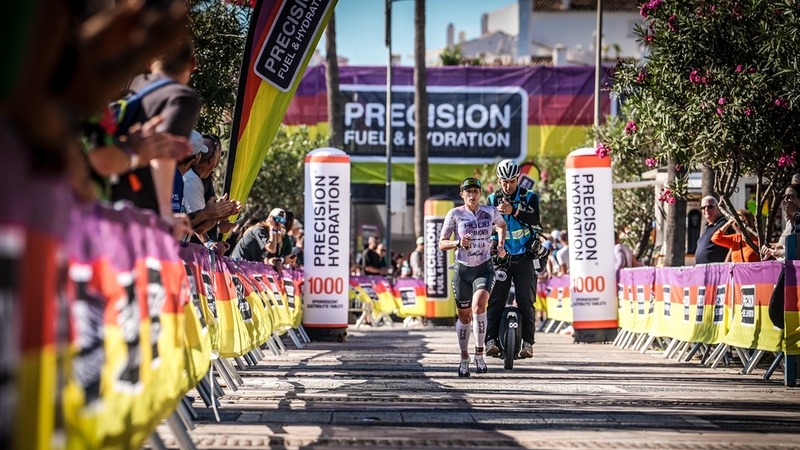
But I think for me, IRONMAN has given us a platform to create these really memorable in-person moments for our customers and the triathlon community. I think we’ve become a bit known for that in the space now. The first really big opportunity for us to showcase our creativity and the brand was when we title partnered the 70.3 World Championship in Marbella last November. For us, that was a real peak moment as a brand.
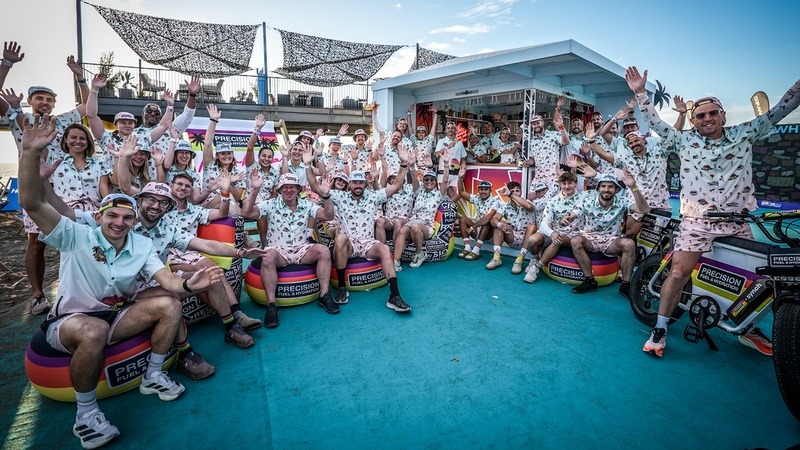
You may have heard us talk about this previously, but Andy and I announced to the team internally that we’d done the deal to title that race and committed to fly every member of staff in the organisation out to Marbella to be part of that experience. So, we had, I think, 53 or 54 sets of flights. Everyone came out. We had multiple houses.
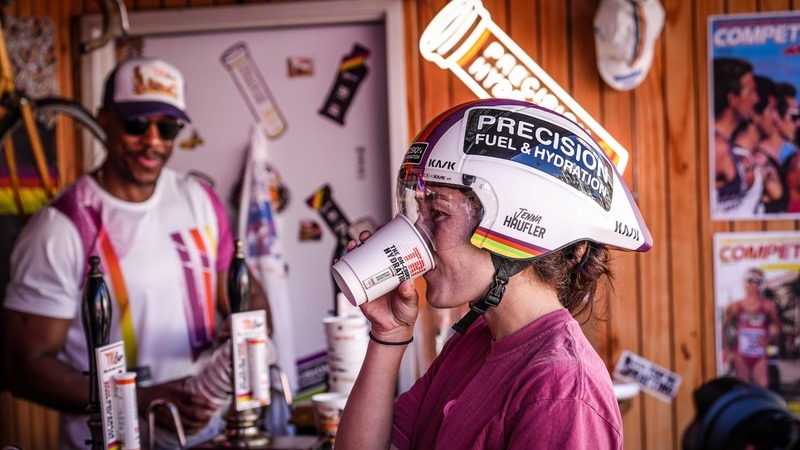
And rather than just having an expo, a retail space where we sold our products, we built a bar in the expo. We did have a shop there too, but it was a really creative experience. Maybe Dave can touch on some of the details of that in a moment, because he’s creative director, one of the guys who’s fundamentally responsible for those bits. But for us, it’s been about trying to create those memorable moments for people to be part of on the ground.
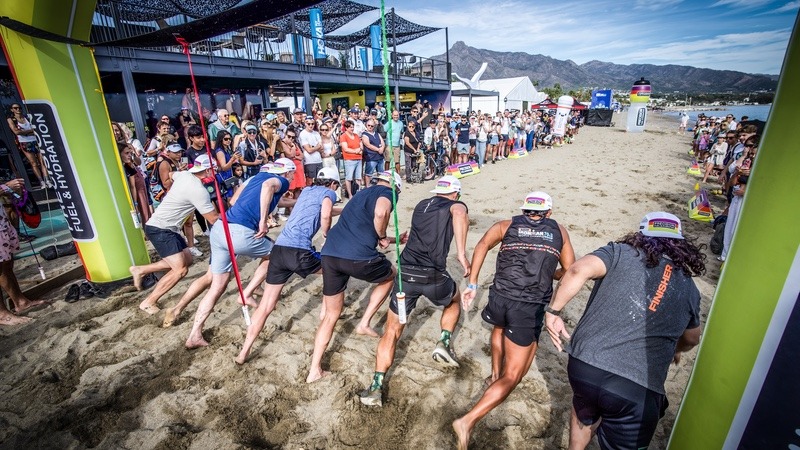
Another thing we did out there was run a 70.3-metre dash on the beach in the few days before the World Championship. It was a bit of fun: a sprint race out and back round a massive inflatable bottle, with a lot of jostling and silliness on the beach. We had Paul Kaye and Joanna Murphy commentating, which was really good.
For me, that was a peak moment for the brand, as I said earlier, culminating in Andy and I holding the finish tape when Jelle Geens, one of our pro athletes, won that race. He won the world title for a second year running in a sprint finish, with Kristian Blummenfelt just behind him, taking the tape from us with most of the team stood on the sidelines. It was a moment you couldn’t have written, really.
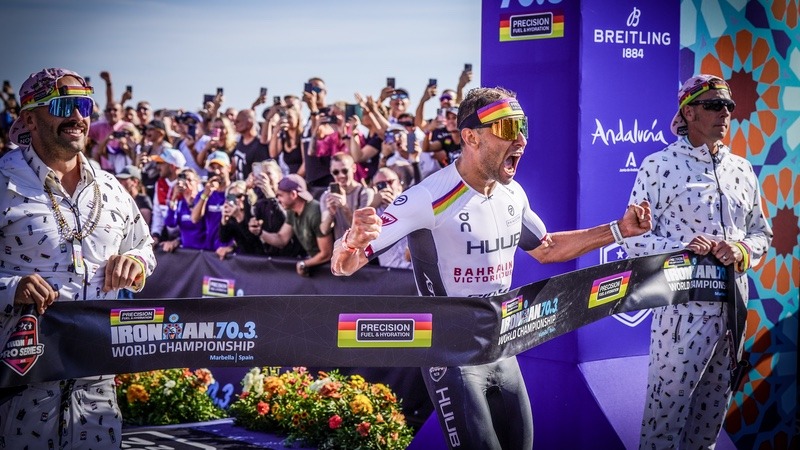
Looking back on it, for me that’s one of the proudest things that we’ve been able to do through the IRONMAN partnership: create those moments for people to be part of along the way.
Dave Colley: Definitely, yeah, and we’ve built on that this year as well. I don’t know if you’ve seen, but we’ve had a 1980s-themed campaign across all our IRONMAN activations this year. The 80s was a formative decade for the sport of triathlon, and IRONMAN in particular, after it was founded in the 70s.
So, we’ve had the Tri Bar, which started in Marbella, and we carried that theme on because it’s the on-course hydration. You can come and try the on-course hydration at the Tri Bar. And then we had a bunch of memorabilia from the unofficial historian of triathlon, Bob Babbitt. Mark Allen gave us some stuff. Zoot, one of the other partners of IRONMAN, and Quintana Roo have all given us original bits of memorabilia from the 80s that we’ve had on display.
So our expo activation is not just about buying the products. It’s about creating some memorable, fun experiences that add to the week before your big race, and that’s been a real pleasure for me. In particular, we did a Sports Illustrated-style 1980s magazine that had some original reporting from Bob, from his Competitor magazine days in the 80s. And it’s been great being able to celebrate the early heroes of the sport. Without those guys, we wouldn’t have a sport here to be a title partner and official hydration partner of.
So that’s been very good fun. We’re doing it again in Kona next week, as the final hurrah for the 80s campaign. Then we’ll have to think of something different next year. But it’s been good fun.
Endurance.Biz: Yeah, definitely. And Zoot and co have been long-standing sponsors of IRONMAN, haven’t they? So it’s pretty cool to work with them.
Jonny Tye: Dave actually pulled some of the original 1980s ads from those partners and included them in the magazine that we recreated this year, so there’s some real authenticity brought through in those magazines too. If you get into the detail of the creative, it’s amazing what the guys internally here are putting together.
Endurance.Biz: Yeah, nice. Were there some funny ones, old fashioned tri suits, with athletes looking like there’s basically nothing on?
Dave Colley: Pretty much. Some really funny stuff, actually. Bob could talk about that stuff for weeks, so it’s been a real pleasure being able to do that with him in particular.
Endurance.Biz: Yeah, I can imagine. This is kind of a follow-up question, but how do you measure the success of this partnership? Are there specific metrics or outcomes that you guys look at?
Jonny Tye: Yeah, I think it’s very difficult to measure the success of a partnership at this scale from a single data point. So you’ve got to look at it from lots of different perspectives and gain an understanding of success across lots of different outcomes.
Basically, we ask our customers, once they’ve purchased from us, where they heard about us. So we collect some data on that, and IRONMAN is an option there, alongside other partnerships that we’ve got. We obviously look at trackable traffic and digital touchpoints, and we have a starter pack of kit available in the IRONMAN registration pathway. So looking at direct sales through that channel is interesting, and you can obviously measure retention of those customers pretty directly off the back of that.
You also get a bit of a subjective feel for growth with IRONMAN from being on the ground. One of the things I love to do is walk through transition on the morning of race day. There’s nothing that beats it for me: walking through and seeing the number of multi-strength bottles on bikes, and gels and chews popping out of top tubes, and that’s grown over the years we’ve been working with IRONMAN.
So across the board, you’re looking at all of these things and working closely with IRONMAN to see that what we’re doing makes a difference. Like I say, it’s very difficult to attribute activity directly to sales a lot of the time, so you’ve got to look at a broad range of metrics to get a good idea of what success looks like.
Dave Colley: Definitely. We also create a lot of content around these events, so we look at the metrics around that content. We’ve got a crew of us going out to Kona next week, and we’ve got a big content plan. It’s a great place to capture content with the pro athletes. We’ve got 20 pros racing in Kona, so it’s a great platform to do content there, which we can obviously measure.
Another thing, and it sounds like an interview answer, is how much fun you’re having and how much fun the team is having. Jonny mentioned Marbella was a marquee moment for us as a brand and a business. It really did feel like a milestone, and we’ve talked about it as a company and as a team a lot of times since then.
And some of the content that we’ve created, like the 80s campaign I talked about, is some of the most fun I’ve had with this business. So that is genuine. If we’re creating stuff that we enjoy, and hopefully some people in the triathlon community enjoy as well, that’s obviously part of it. What’s the point in doing stuff if it’s not fun, right?
Endurance.Biz: Yeah, for sure. That’s really interesting. And looking ahead, what would you like to achieve in this partnership that you feel you haven’t achieved so far?
Dave Colley: Yeah. So we’ve talked a lot about the experiential activations that we’ve done on the ground. That’s definitely been the focus for us this year, particularly in the run-up to Marbella, with it being the first time we were title partner of an IRONMAN race.
But before that, and as part of the IRONMAN package, we’ve got a bunch of digital activations that we put quite a bit into early on in the partnership in 2024 and probably haven’t focused on enough in the last year or so, because we’ve been doing these big in-real-life experiences on the ground.
So it’s probably about redressing the balance a bit there. IRONMAN’s got a huge audience. They’ve got a lot of athletes participating in their races, and a lot of digital touchpoints and emails. We’ve always prided ourselves on the quality of our educational material. It’s meant to be educational, but fun at the same time. And we probably haven’t done enough to get that stuff out there on IRONMAN’s digital channels.
So I think we’ll be focusing a bit more on that. As we’re growing the team, that becomes a bit easier, because you’ve got more resource to focus on testing and on leveraging that partnership more. Anything you want to add to that, JT, or does that cover it?
Jonny Tye: No, I agree. I think it’s about doubling down on what we’ve been doing on the ground. And one thing I would say, just touching on that, is that we’ve had real support from IRONMAN in doing those in-person activations. Scott DeRue, the CEO of IRONMAN, has made quite a big thing about improving the athlete experience, so we’re very aligned with IRONMAN on that vision, and I think that comes from those in-person moments that really elevate your experience on the ground.
But to Dave’s point, helping educate athletes through their training on how to fuel and how to hydrate, so they have a better experience on race day from a performance standpoint, all aligns with that top-level vision from IRONMAN’s perspective too. So yeah, doubling down on what we’ve done already, and resourcing up so that we can do a little bit more on the digital side, as Dave says.
Endurance.Biz: That makes sense. Now, how important are triathletes as an audience to you as a business, versus cyclists, runners and swimmers? Obviously they’re all kind of similar, but how do triathletes specifically compare?
Jonny Tye: Yeah, as Dave said at the start of this interview, Andy, one of the co-founders of the business, was a semi-professional triathlete back in the day. So triathlon is in our DNA as a business, and we put a huge emphasis on that audience. We’ve grown up in that space, and we’re very much part of that community.
But I think we also feel we are an endurance brand rather than a triathlon brand. So we work in cycling: we work with the Pro Tour cycling team Lotto. We do a lot in ultra running and trail running, and a bit more in marathon running over the last year or so too. So triathlon is, I guess, the founding story and the backbone of where we’ve come from, but as a brand, we certainly operate in that broader endurance space.
And I think certainly over the last two or three years, Dave, we’ve popped up in increasing ways in those other sport verticals too. The first time we turned up at Western States… I think we might be in our fourth year there now. On that first run out we had one pro athlete there, and it culminated a couple of years ago in Caleb Olson, one of our athletes, winning the event, with five of our athletes finishing in the top 10.
So yeah, our products, content and education materials are very much built to support athletes in the broader endurance community, rather than just triathlon.
Dave Colley: Yeah, so we are an endurance sport business for sure, and that’s the lion’s share of our business. But another bit of backstory is that a big part of the early business, and we still do this, was working with pro teams in the NFL, the NBA, the top international rugby teams, Premier League soccer, all that stuff, Formula One, a lot of top tennis players, boxers. So that’s always been part of our business as well. It’s just a smaller part these days than it was at the start. It really was paying the bills in some of those early days.
But yes, we’ve always been across all of those endurance sports. Our content, the newsletter that we’ve done once or twice a week for 11 years, has always had a mix of stuff that’s relevant to endurance athletes generally, and then across all of those sports.
Endurance.Biz: I didn’t know that you worked with those other sports as well. That’s pretty cool. Another triathlon question, although it’s kind of a statement: it feels like triathlon is having a bit of a renaissance at the moment. Do you agree with that, or not?
Jonny Tye: Yeah, I think it’s a very fair thing to say. Certainly from everything we see in the space, through partners and our own data, triathlon seems to be on a really strong bounce back after the tricky time that everyone had through COVID. You’ve only got to look on the internet at how difficult it is to get an IRONMAN entry now to see how competitive it is to get those spots. It’s pretty amazing to see how quickly it’s bounced back, actually.
If you look at Kona next week, and the number of men and the number of women that could win those events, the competitive nature and the depth at the top end of the sport has really broadened in this latest phase. That just creates more excitement around the top end of the sport and more media coverage, and that maybe helps fuel the bottom end of the pyramid too.
And I think you also have to look at the growth in running and gravel, and perhaps some of that growth also feeds across into triathlon too. I don’t know whether you agree with that, Dave.
Dave Colley: Yeah, definitely. I think also, there have always been other races than IRONMANs, but there’s been some reasonable investment in other race platforms and formats over the years, and that competition is probably a good thing, right? It’s spurred IRONMAN on to do some innovative things over the last few years with the Pro Series. So yeah, that general growth in the pro end of the sport, like Jonny said, has made a big difference, I reckon.
Endurance.Biz: Yeah, for sure. I don’t know what you guys think about HYROX. Do you see it as a…
Jonny Tye: I’ll keep my T-shirt on for this interview!
Endurance.Biz: Ha! Do you see it as a competitor, or an opportunity? Do you feel there’s a similarity to triathlon that you can work with, or not at all?
Jonny Tye: Yeah. I think, first of all, it’s exploded. Look at the growth in that sport in just a few years. It’s wild to see what’s happened in that space. But I don’t think I would describe it as a competitor to triathlon per se. I think it could potentially be a bit of a feeder for some people coming out the back of HYROX, on a bit of a fitness journey and looking at other challenges. Going and doing an IRONMAN is a big bucket-list thing for a lot of people, so it could be seen as a feeder.
But conversely, we see it the other way around too. You see cross-pollination from triathlon across to HYROX, and people using it as cross-training through the winter months. I’m not a triathlete myself. I’ve done a couple of HYROX races, as I was interested to see what all the fuss was about. But just in our office here, we’ve had half a dozen people whose core sport is triathlon who’ve dipped in and done a bit of HYROX. They’re doing some of their gym training in that setting, and performing pretty well at HYROX.
I think the attributes of a triathlete, being a really good runner, lend you to performing quite well in HYROX. If you’re reasonably strong and you can run very well, then you can jump across very effectively. So I think you’ll see it a bit like athletes jumping between marathon running, gravel, half IRONMAN and IRONMAN. People like to change it up and switch things around a little bit through the year. So I don’t think it’s a competitor per se. I just think it adds to this space, actually.
Dave Colley: Definitely. We’ve seen that in our athlete support. We do free video consultations for athletes. Anyone, whether you’re a customer or not, can book a 20-minute call with one of our experts and talk about your strategy for whatever you’re training for. And there are definitely people booking calls to talk about fuelling and hydration for HYROX.
We’ve created content specifically for HYROX too, so we’ve got blogs on what to eat and drink before and during HYROX. So we’ve definitely put some things in place to help educate athletes who are training for those events. So yeah, it’s an opportunity for general growth of the endurance sport market, I think, as Jonny said.
Endurance.Biz: Finally, you mentioned gravel a couple of times. Is that something you’re building towards, or not?
Jonny Tye: Yeah, gravel is another big growth area. Gravel riding, and you see a few gravel triathlons popping up now as well, becoming a bit more popular, although they’ve been around for a long, long time. Again, just going on our sample size in the office as well as our customer base, it’s amazing to see that scene growing so aggressively.
We showed up at UNBOUND in a pretty big way, and a bunch of us in the office raced it last year, which was an incredible experience. Certainly one I won’t forget. I was very fortunate that it didn’t rain and we didn’t get too much sticky mud last year. Biggest fluke ever!
But yeah, it’s certainly an interesting space. As we said in answering your last question, it’s another one of those endurance sports that gives people an option to jump into. I think riding on the roads, particularly in the UK, is just becoming harder. I can’t speak for the US. And it’s a lot safer to go and… well, we’re so spoilt where we are here in the New Forest. We can jump on a gravel bike and ride 100 miles without touching the same gravel track twice. So it gives you that cross-training opportunity.
There are some really interesting races popping up around the world that people can throw into their race calendars, which probably complement a triathlon race season rather than detract from it. So yeah, it’s definitely a growing area, and one that we’re getting more involved in as a brand, and as athletes ourselves.
Dave Colley: Yeah, this gravel triathlon concept is not something we’ve directly got involved in, in terms of sponsoring any events or anything like that, yet. But we’ve definitely been talking to athletes who are participating in them.
And I think generally, as Jonny alluded to, the more interesting formats and experiences athletes can have, the better, right? So we’re very positive and supportive of governing bodies and race directors trying to do more interesting and different things. As athletes ourselves, having more variety of experiences that you can go and have as an endurance athlete is only a good thing, right?
PF&H provides personalised sports fuelling and hydration solutions, working with elite athletes, national federations, and everyday endurance athletes across running, cycling, triathlon, and other sports. Through its sweat testing technology, online planning tools, and range of gels, chews, and electrolyte drinks, the company helps athletes eliminate guesswork and build strategies tailored to their physiology and event conditions.