


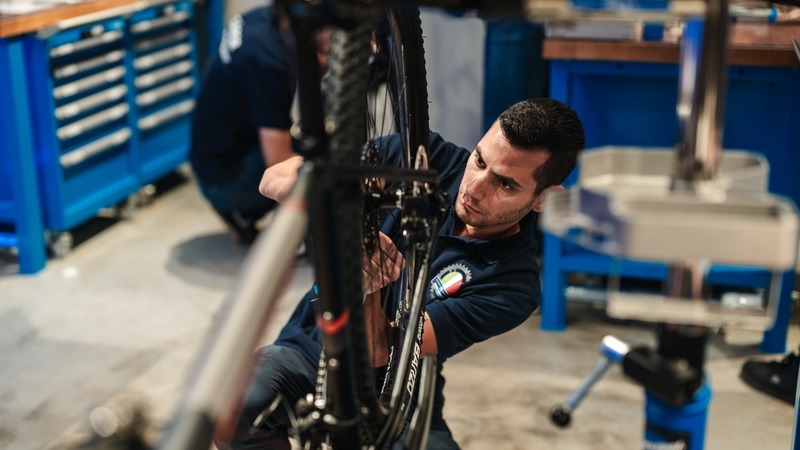
Europe’s bicycle industry will need to recruit around 105,000 additional bike mechanics by 2032 – a requirement equivalent to 60% of its current total workforce – according to new analysis published by the NextGen Mechanics initiative and trade body European Cycling Industries (ECI).
Launched at the European Cycling Industries Summit in Brussels, the report offers a bottom-up estimate of demand for cycle mechanics built from retail employment data. It reveals that Europe currently employs approximately 175,000 cycle mechanics, with employers needing an estimated 45,000 more to satisfy current demand.
Meeting projected demand by 2032, including replacing departing staff, would require the European maintenance workforce to expand from 175,000 to nearly 250,000, representing a growth of roughly 40%.
The shortage is already influencing travel habits across the region. A Shimano State of the Nation 2026 survey of 25,000 respondents found that 212 million people in Europe experience barriers to maintaining their bikes. Consequently, 121 million people cycle less, whilst 7.6 million have stopped cycling altogether.
The report notes that the job itself has evolved faster than the profession’s status or remuneration. Modern mechanics handle firmware, battery systems, and digital drivetrains, yet pay across Europe remains below the national median for full-time employment, even in well-established markets.
Data from OOMT, the Dutch training and development fund for the motor vehicle and two-wheeler sector, indicated that 24% of mechanics left the industry in the Netherlands in 2024. If replicated across Europe, that attrition rate would increase the current shortfall by 15,000.
Safety risks are also highlighted in the report. Research by SWOV, the Dutch Institute for Road Safety Research, found that cyclists attributed 10% of cycling accidents to mechanical defects, with poor maintenance contributing to 45% of those incidents. The lack of access to professional workshops has also led to an expanding informal repair market, including for illegally modified e-bikes that standard workshops decline to service.
Paul Walsh, CEO of ECI, said “A bicycle that cannot be repaired is a bicycle that stops being ridden. This is not a problem for bike shops alone, but also for the wider cycling ecosystem. Europe’s capacity to train and retain qualified bicycle mechanics is falling behind demand, with an impact felt by both consumers and businesses.
“This undermines a fast-growing European industry and limits the return regions and cities see on their cycling infrastructure investments. European Cycling Industries is honoured to take forward the recommendations in Shimano’s report, on behalf of the entire industry.”
To address these issues, the European Cycling Industries (ECI) is establishing an Education and Skills Expert Group (ESEG) to advance the report’s recommendations. ECI is inviting pioneer cities and industry partners to participate in immediate priorities, which include:
- Conducting a pan-European, sector-wide needs assessment to identify key sub-sector challenges and map current and future skill gaps across the cycling industry.
- Partnering with expert VET providers to build a standardised, replicable European training framework for bicycle mechanics.
- Piloting newly developed VET frameworks alongside cities and industry partners to ensure real-world viability and scalable implementation across Europe.
The publication outlines 27 recommendations in total, spanning workforce support, recruitment, vocational education frameworks, maintenance economics, and structural action.
Ties Van Dijk, Advocacy & Strategy at Shimano, said “We know from talking with bike shops that the workshop matters more to their business every year, and they cannot find the people to staff it. We convened NextGen Mechanics to understand the problem properly and are pleased to collaborate with ECI ongoing trying to solve it, because no single company can fix this alone.”
The report arrives as the NextGen Mechanics initiative transitions into a permanent working group under ECI, the organisation formed following the merger of Cycling Industries Europe and CONEBI.
Speaking at the summit in Brussels, Mario Nava, Director-General for Employment, Social Affairs and Inclusion at the European Commission, added “Bicycle mechanics is something that can’t be replaced by AI; bike mechanics are a job of the future, and we will need many more for the future, as many more people will cycle.”